Today, Rose Island is internationally renowned for day-trip catamarans, beach bars, and friendly swimming pigs. Yet beneath this sun-soaked surface lies a rich, turbulent, and surprisingly dramatic maritime history spanning five centuries.
The island has served as an indigenous fishing territory, a pirate staging anchorage during the Golden Age of Piracy, an 18th-century Loyalist pineapple plantation, the graveyard of a dynamited 1929 steam freighter, and—most dramatically—the site of a $750 million luxury mega-resort collapse whose multi-jurisdictional legal battles lasted until March 2025.
Here is the authentic, documented history of Rose Island: primary colonial diaries, underwater archaeology, and the financial catastrophe that accidentally saved the island from mass urbanization.
Rose Island Historical Milestones (TL;DR)
- Indigenous & Pirate Era (1500–1720): Fished by indigenous Lucayans prior to Spanish slave raids. Later used by privateers and Royal Navy squadrons under Governor Woodes Rogers as a sheltered eastern anchorage protecting Nassau Harbour.
- The 1823 Townsend Diary: The earliest primary written account of Rose Island appears in the diary of American physician Dr. Peter Solomon Townsend, documenting permanent plantation houses and confirming the island was covered in native broadleaf brushwood and coconut palms decades before invasive Australian casuarinas were introduced in 1859.
- The 1929 Mahoney Shipwreck: A 212-foot steel steam freighter grounded on the reef bar and dynamited by British colonial authorities to clear the shipping channel, creating today’s premier artificial reef.
- The $750M Ritz-Carlton Collapse (2005–2025): Marriott and Miami developer Gencom planned a 400-acre mega-resort and deep-water marina that Prime Minister Perry Christie predicted would create “zero unemployment.” The 2008 global financial crisis paralyzed construction, triggering 17 years of multi-million-dollar lawsuits in Florida and The Bahamas until final dismissal on March 27, 2025.
- The Preservation Irony: Two decades of legal stalemate permanently halted development, saving Rose Island from high-density hotel towers and preserving it as a pristine day-excursion paradise.
Indigenous Lucayan Origins & The Pirate Republic (1500–1720)
Before European contact, the shallow banks and mangrove fringes of New Providence and Rose Island were fished by the indigenous Lucayan Taino people, who navigated the archipelago in dugout cedar canoes (canoas) harvesting queen conch, spiny lobster, and bonefish. Following Christopher Columbus’s 1492 landfall in San Salvador, Spanish slave raids between 1495 and 1520 completely depopulated the Lucayan population across The Bahamas.
By the late 1600s, British settlers colonized New Providence, establishing the settlement of Charles Town (later renamed Nassau in 1695). During the Golden Age of Piracy (1690–1720), when Nassau functioned as an outlaw pirate republic governed by infamous figures like Edward “Blackbeard” Teach, Benjamin Hornigold, and Calico Jack Rackham, Rose Island played a critical tactical role.
Because prevailing winds and ocean currents funnel vessels through the Northeast Providence Channel into Nassau Harbour, pirate lookouts stationed on Athol Island and the limestone ridge of Rose Island could spot incoming Spanish galleons and British merchantmen hours before they reached port. The sheltered leeward sandbars along Rose Island’s southern shore provided a protected anchorage where pirate vessels could careen their hulls (scraping off shipworms and barnacles) away from colonial authorities.
In 1718, when Great Britain declared The Bahamas a Crown Colony and dispatched former privateer Captain Woodes Rogers as Royal Governor to suppress piracy, British naval frigates utilized Rose Island’s leeward waters as a staging post to blockade the eastern channel.
Loyalist Plantations & Dr. Townsend’s 1823 Journal
Following the American Revolutionary War in the 1780s, thousands of British Loyalists fled the newly formed United States, relocating to The Bahamas with enslaved laborers to establish agricultural estates modeled after Southern plantations.
The earliest surviving primary eyewitness account of daily life on Rose Island comes from the personal journal of Dr. Peter Solomon Townsend, an American physician from New York who resided in Nassau from December 1823 to September 1824 (transcribed and published by the Bahamas Historical Society in 1968):
"Approaching Nassau Harbour from North Eleuthera in December 1823,
 several permanent houses were observed standing upon Rose Island...
 covered in low native broadleaf coppice and coconut palms,
 with small clearings established for pineapple and coastal ground crops."
 — Dr. Peter Solomon Townsend, Nassau Journal (1823)
Dr. Townsend’s botanical observations provide crucial historical baseline data: in the 1820s, Rose Island had zero Australian casuarina pines (Casuarina equisetifolia). The invasive pine trees that now line much of Rose Island’s beaches were not introduced to The Bahamas until 1859, naturalizing along coastlines only in the early 20th century.
Throughout the 19th and early 20th centuries, small landholding families on Rose Island cultivated the famous sweet Bahamian pineapple alongside sweet potatoes, peas, and citrus, while supplying salt-fish and conch to the Nassau market until the British abolition of slavery in 1834 shifted the economy toward maritime wrecking and sponging.
The 1929 Mahoney Shipwreck & Mid-Century Conservation
In 1929, Rose Island’s northern maritime boundary gained its most famous underwater archaeological feature. The Mahoney, a 212-foot steel-hulled steam freighter built in the late 19th century, was transiting the eastern channel into Nassau Harbour during a fierce Atlantic squall when it struck the shallow barrier reef.
Colonial maritime authorities determined that the grounded hull blocked navigation into the harbour’s secondary channel. Royal colonial engineers dynamited the vessel, scattering heavy iron plates, structural framing, and steam boilers across the seafloor in 12 to 20 feet of water. Over the ensuing decades, coral polyps colonized the steel plates, creating an artificial reef teeming with marine biodiversity.
By the 1950s, as international marine scientists and Bahamian conservationists organized the landmark 1957 Exuma Cays survey that birthed the modern Bahamas National Trust (BNT) park system, scientific assessments explicitly singled out the coral reefs of Rose Island as a foundational example of the “Bahamian essence” that underpinned the colony’s emerging ecotourism economy prior to national independence on July 10, 1973.
The $750 Million Ritz-Carlton Mega-Resort Collapse (2005–2025)
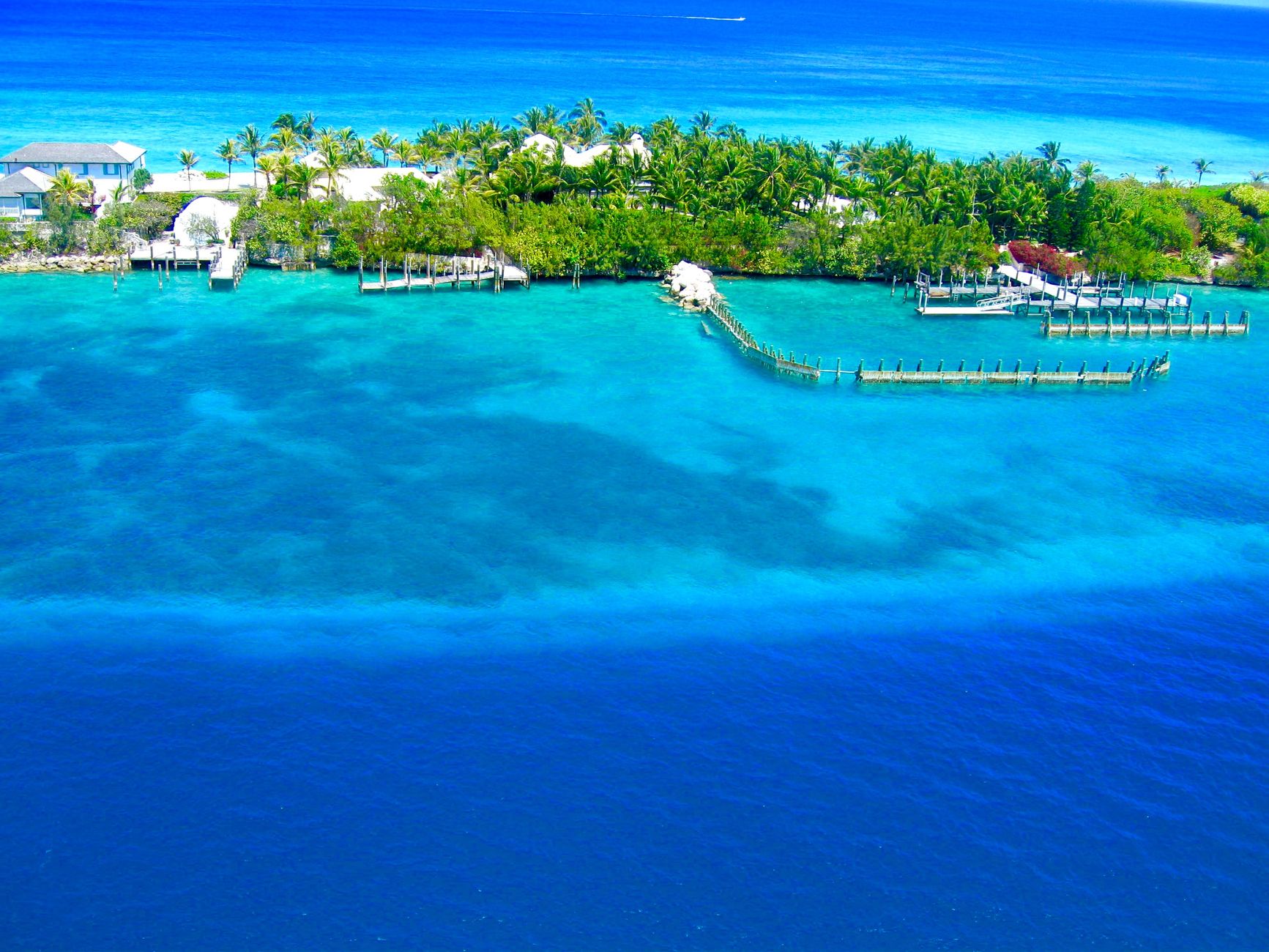
The defining modern event in Rose Island’s history was the spectacular rise and catastrophic collapse of the $750 Million Ritz-Carlton Rose Island Resort and Marina.
The Mega-Resort Vision (2005–2007)
In November 2005, Marriott International, Inc. incorporated the Ritz-Carlton Rose Island Hotel Company, Ltd. (RCRI) under Bahamian law in a joint development partnership with Miami-based Gencom Group (headed by founder Karim Alibhai, with Nick Ward as managing director of RCRI).
The vision was staggering in scope:
- A 400-plus-acre master-planned ultra-luxury compound spanning the central and western sectors of Rose Island.
- A 200-room Ritz-Carlton hotel, 150 private estate homes, 80 residential villas, and a deep-water megayacht marina dredged through the barrier cay.
- In December 2006, then-Bahamian Prime Minister Perry Christie announced that groundbreaking would commence in March 2007, publicly predicting that the project would generate “zero unemployment” across The Bahamas upon its projected 2011 grand opening.
The 2008 Crash and Total Abandonment
Marine engineering firm American Bridge (Bahamas) Ltd. mobilized heavy dredging equipment to Rose Island, excavating the deep-water marina basin under monthly environmental monitoring by the Bahamas Environment, Science and Technology (BEST) Commission through early 2008.
Then, the September 2008 global financial crisis struck. International debt markets froze, financing evaporated, and construction on Rose Island halted instantly. The developers abandoned the excavated marina cut, laid off contractors, and locked the project gates forever.
Nearly Two Decades of High-Stakes Litigation
The collapse triggered seventeen years of bitter multi-jurisdictional lawsuits:
- American Bridge v. Marriott & Gencom ($21M Verdict): American Bridge sued RCRI and Marriott International over millions in unpaid marina dredging contracts. After winning a Bahamian judgment, the contractor secured a stunning $21 million jury verdict in Florida in May 2014 (enforcing a $7.59 million underlying Bahamian arbitration award).
- The 2015 Florida Appeals Reversal: On December 16, 2015, the Florida Third District Court of Appeal (Marriott International, Inc. v. American Bridge Bahamas, Ltd.) reversed the judgment on all counts, ruling that American Bridge had failed to legally pierce the Bahamian corporate veil of RCRI to hold parent company Marriott liable.
- The Final March 2025 Bahamian Supreme Court Ruling: Litigation dragged into the mid-2020s. On March 27, 2025, Bahamian Supreme Court Senior Justice Fraser issued a landmark ruling dismissing a $7.5 million lawsuit brought by original land-selling investors (the Lovejoy family entities) against successor entity LRLA Rose Island, cementing the total legal death of the mega-resort project.
How Failure Accidentally Saved Rose Island
In retrospect, the collapse of the Ritz-Carlton mega-project was the best ecological event that could have happened to Rose Island.
Had the project succeeded, Rose Island today would resemble an overcrowded gated suburb of Miami, covered in high-density concrete hotel towers, golf courses, manicured lawns treated with chemical fertilizers, and hundreds of roaring jet skis polluting the barrier reef.
Instead, nearly two decades of legal gridlock permanently paralyzed mega-resort development. In their place, innovative Bahamian entrepreneurs created low-impact, barefoot day-excursion beach clubs like Sandy Toes, Da Pig Beach, and Footprints.
Today, over 95% of Rose Island remains completely uninhabited, wild, and off-grid—preserving an authentic Bahamian Out-Island sanctuary just six miles from the bustling capital of Nassau.
Frequently Asked Questions Regarding Island History
Are there any ancient ruins or pirate artifacts on Rose Island today?
Did anyone live permanently on Rose Island historically?
Is anyone trying to build mega-resorts on Rose Island now?
Experience Rose Island's Living History
Snorkel the historic 1929 Mahoney steamship wreck and relax on beaches untouched by mega-resorts.
View Rose Island Excursions & Shipwreck Tours →Ready to Experience Rose Island Bahamas?
Book a verified day excursion covering the swimming pigs, barrier reef snorkeling, and beach club relaxation with guaranteed on-time return to Nassau Cruise Port.